Traumatic Experiences and the Brain To understand how trauma affects the brain, it helps to think of the brain as a team of different parts working together. Each part has a job. When things are working well, these parts help us think clearly, feel balanced, remember things in order, and respond to life in a …

Traumatic Experiences and the Brain
To understand how trauma affects the brain, it helps to think of the brain as a team of different parts working together. Each part has a job. When things are working well, these parts help us think clearly, feel balanced, remember things in order, and respond to life in a healthy way.
But during trauma, this system gets overwhelmed. Several key parts of the brain become very important in this process: the amygdala, hippocampus, thalamus, and frontal cortex.
The amygdala is like the brain’s alarm system. Its job is to quickly notice danger. It helps protect us by reacting fast when something might be unsafe. It does not wait for full information. It reacts first, sometimes before we even realize it. During trauma, this alarm system can become too active. It may stay “on” even when there is no real danger. This can make a person feel anxious, scared, or always on edge.
The hippocampus is the part of the brain that helps organize memories. It helps us understand when something happened and whether it is in the past or present. It also helps make memories feel like stories we can remember later. During trauma, this system can be disrupted. Memories may feel confusing, broken into pieces, or too vivid. Sometimes the brain has trouble telling the difference between “then” and “now.” This is why flashbacks can happen, where it feels like the event is happening all over again.
The thalamus works like a relay station. It takes in information from our senses—like sight, sound, and touch—and sends it to the right parts of the brain. It helps organize what we experience so it makes sense. During trauma, this system can become less accurate. Things may feel confusing, unreal, or disconnected. Some people may feel numb or like they are not fully present. This is called dissociation, and it is the brain’s way of protecting itself when things feel overwhelming.
The frontal cortex is the thinking part of the brain. It helps us make decisions, solve problems, and control our emotions. It allows us to pause and think before we react. During trauma, this part of the brain can become less active. When that happens, it becomes harder to think clearly, stay calm, or control strong emotions. People may react quickly or feel overwhelmed by their feelings.
When we look at all of these parts together, we can better understand what happens in trauma. The amygdala becomes too active and keeps the body in a state of fear. The frontal cortex becomes less active, making it harder to calm down or think clearly. The hippocampus has trouble organizing memories, which can lead to flashbacks. The thalamus may not process information clearly, which can cause feelings of numbness or disconnection.
Over time, these changes can lead to symptoms of post-traumatic stress disorder (PTSD). These can include unwanted memories that keep coming back, avoiding reminders of the trauma, feeling on edge, trouble sleeping, and changes in mood or thinking.
The Neuroscience of Predictive Mindset and the Brain
Another helpful way to understand the brain is to think of it as a prediction system. The brain is always trying to guess what will happen next based on past experiences. It uses these guesses to help keep us safe.
In his book The Experience Machine, Andy Clark gives a simple example. Imagine you are walking in the woods and see something on the ground that looks like a snake. Your brain quickly predicts danger. Before you even fully think about it, you jump back. This happens because your brain is trying to protect you. It is better to react quickly and be wrong than to miss a real danger.
Then you look again and see it is just a stick. Your brain updates its prediction. It learns from the mistake and adjusts for next time. This process is called prediction error correction. It is how the brain learns and improves over time.
Trauma can affect this system. After trauma, the brain may start to expect danger even when things are safe. It may “overpredict” threat. This can make a person feel unsafe in situations that are actually fine.
Even small things that do not match what the brain expects can cause strong reactions. The brain becomes very sensitive, always scanning for danger. Because of this, it can be hard for the brain to update its predictions and learn that things are safe again.
Trauma can also make it harder for the brain to put together all the pieces of an experience. Thoughts, feelings, and senses may not connect in a smooth way. This can lead to flashbacks, strong emotional reactions, or feeling like the past is happening again.
The same parts of the brain we talked about earlier are also involved in this prediction system. The amygdala pushes the brain to expect danger. The frontal cortex helps update those predictions. The hippocampus helps add context, like when something happened. The thalamus helps bring in accurate sensory information.
When trauma affects these systems, the brain can get “stuck” in old predictions. Even when life is safe now, the brain may still act like danger is present.
The important thing to understand is this: these responses are not signs that something is wrong with you. They are signs that your brain learned to protect you during overwhelming experiences. These patterns were helpful at the time, even if they feel difficult now.
When people understand this, it can help them see trauma differently. Instead of thinking “this is who I am,” they can begin to understand “this is how my brain learned to respond.”
What follows is a simpler way I often explain this using everyday language and imagery to help make it easier to understand and relate to.
This Is Your Brain… This Is Your Brain on Trauma
Imagine, for a moment, that your brain is not something hidden quietly inside your skull, but a vast warehouse complex stretching farther than the eye can see. The air inside hums with constant activity. Conveyor belts glide steadily in every direction, carrying boxes of all shapes and sizes. Overhead lights cast a soft industrial glow across rows of towering shelves that seem to go on forever. There is a rhythm here, a system that rarely stops, a quiet sense that everything has its place and purpose.
At the very center of this operation moves the warehouse manager, the Amygdala. It does not sit still. It walks the floor with urgency, scanning every incoming package, every sound, every shift in the environment. Its eyes are sharp, its movements efficient, and its attention never drifts for long. It carries an invisible checklist, constantly asking questions without words: Is this safe? Is this dangerous? Do I need to act right now? Nothing enters the warehouse without passing under its watchful awareness, even if only for a fraction of a moment.
Just beyond the main floor stands the entrance, where large metal doors slide open and shut as information arrives from the outside world. This is the Thalamus, the gateway. Trucks pull in endlessly, unloading sensory information—sights, sounds, textures, tastes—each one arriving like a shipment that must be processed. The Thalamus receives it all with quiet efficiency, directing each piece inward to where it needs to go. There is a steady flow here, organized and dependable. Yet there is one exception to this orderly process. Smell moves differently. It slips through a side entrance, bypassing the main doors entirely, entering deeper into the warehouse without waiting its turn. It moves quietly, almost invisibly, until suddenly it isn’t, arriving with a kind of immediacy that can feel surprising and powerful.
Further inside the warehouse, beyond the constant motion of the main floor, the space opens into long aisles filled with carefully arranged shelves. This is where the Hippocampus works, the storage area responsible for organizing everything that has ever come through. Here, each experience is placed into a box. The box is folded, sealed, labeled, and filed with care. There is intention in every movement, a quiet dedication to keeping things orderly so that nothing is lost. If something needs to be found later, it can be retrieved because it has been stored properly. Above it all, overlooking the entire operation from behind glass walls, sits the Frontal Cortex, the executive office. From this vantage point, everything can be observed with distance and perspective. Decisions are made here. Plans are considered. Reactions are slowed down and shaped into thoughtful responses rather than immediate impulses. When the system is working as intended, there is a balance between the urgency of the warehouse manager and the calm oversight of the executive office.
Most of what happens in this warehouse unfolds without awareness. Even now, as you read these words, shipments continue to arrive. A faint sound in the background. The feeling of the chair beneath you. The subtle shift of your breathing. Each of these enters through the doors, gets sorted, checked, and sent along. The warehouse manager moves quickly, evaluating everything almost instantly. It notices changes in temperature, small movements, passing thoughts. It wonders quietly: Is something off? Did we forget something? Is there something we need to prepare for? This all happens at a speed so fast it feels invisible, long before the executive office has time to weigh in.
Under normal conditions, the system flows smoothly. Information comes in, gets processed, and is placed into a box. The box is sealed, labeled, and sent down to storage. The warehouse thrives on this sense of completion. There is a beginning, a middle, and an end to each experience. Once stored, it no longer interferes with the present moment. It becomes part of the larger collection, something that can be revisited if needed but does not demand attention.
But sometimes, something arrives that disrupts this process. It does not have to be large or dramatic. Trauma is not defined by how something appears from the outside, but by how overwhelming it feels to the system when it arrives. It could be something that others might recognize as significant, or it could be something quieter, like a moment of rejection, a harsh word, or a feeling of being unsafe in a place that should have felt secure. What matters is not the size of the event, but the impact it has on the warehouse as it tries to process it.
When that kind of experience enters, the shift is immediate. The warehouse manager notices it, and everything changes. Alarms begin to sound, echoing through the space. Red lights flash along the walls. The steady rhythm of the conveyor belts falters as urgency floods the system. The manager moves quickly, attempting to reach the executive office for guidance. But when it looks up, the doors are closed. The lights inside are off. A sign hangs where it can be clearly seen: “We are closed for two weeks. Please come back later.” In that moment, there is no time to wait, no ability to pause and think things through. The system cannot rely on thoughtful planning or careful decision-making. The warehouse manager is left alone to respond.
So it does what it is designed to do. It activates emergency protocols. Fight. Flight. Freeze. Fawn. The goal shifts instantly from understanding to survival. Every resource is directed toward getting through the moment. The system narrows its focus, prioritizing safety above all else. And eventually, the moment passes. The alarms quiet. The lights dim. The warehouse begins to settle again.
But something is different now. The experience remains, and the manager attempts to handle it the way it handles everything else. It tries to place it into a box, to fold it neatly, to seal it shut. Yet something about it resists. The edges do not align. The lid will not fully close. It feels unstable, as though sealing it too quickly might cause it to burst open later, spilling into everything around it. There is hesitation. Uncertainty. And so, instead of completing the process, the manager sets the box aside. It remains open, unfinished, and unfiled.
At first, it seems like a small thing, just one open box resting off to the side of the warehouse floor. But in a system built on order and completion, it stands out. It draws attention. The manager is aware of it, even while continuing its work. Over time, if the system is able, the manager may return to it, carefully sorting through its contents, making sense of what is inside. If that happens, the box can eventually be closed, sealed, and stored away like all the others. Balance returns. The warehouse resumes its steady rhythm.
But sometimes, the box remains where it is. Days pass. Then weeks. The manager begins to notice it more often. Its presence creates a subtle tension, a quiet disruption in the flow of the warehouse. Without realizing it, the manager starts to watch everything more closely. Each new package that enters is examined with a sharper eye. Does this resemble that box? Could this be connected? Is there something here that needs to be handled before it becomes another problem?
Gradually, the entire system shifts. The warehouse becomes more alert, more reactive. The lights seem harsher. The sounds feel louder. The pace feels faster. What was once a place of calm organization now carries an undercurrent of urgency. The system is not broken; it is trying to protect itself. But in doing so, it begins to operate from a place of constant readiness, always prepared for something to go wrong.
If more open boxes begin to accumulate, the tension increases. The manager becomes overwhelmed, trying to keep track of everything at once. Stress chemicals flood the system like heat rising in the warehouse, creating pressure that never fully dissipates. Incoming experiences no longer move cleanly through the system. As they pass through, they brush against the open boxes, picking up fragments, absorbing emotional residue that has not yet been processed.
And so the warehouse continues to operate, doing the best it can with what it is carrying. It keeps moving, keeps sorting, keeps responding. But somewhere on the floor, there may be boxes that remain open, quietly influencing everything that passes through. You can almost picture the manager moving around them, adjusting its path without fully realizing it, giving certain areas a wider berth, pausing just a little longer when something unfamiliar comes in. Even when nothing obvious is happening, there is a subtle tension in the air, like the system is always accounting for something unfinished.
Eye Movement Desensitization and Reprocessing (EMDR)
Now imagine stepping back into that same warehouse, only this time with a different intention. Not just to observe it or understand how it works, but to begin gently restoring order to what has been left unfinished. The conveyor belts are still moving, the lights still hum overhead, and the warehouse manager is still pacing the floor, scanning, sorting, staying alert. But now there is a quiet awareness that some of the boxes sitting off to the side have been there for a long time. They haven’t been forgotten. If anything, they have been quietly shaping everything that moves through the system.
In some warehouses, you might begin to notice certain patterns that have developed over time. The manager startles easily, reacting to sudden noises as if something has gone wrong. Even when the floor is relatively calm, there is a constant sense of readiness, like the system is bracing for something that hasn’t happened yet. The lights feel too bright, the sounds too sharp, and the manager keeps scanning every incoming package with intensity, searching for anything that might resemble those open boxes still sitting on the floor. It isn’t choosing to be this way—it has learned that staying alert is the safest option.
At times, without warning, one of those open boxes gets bumped. Maybe a passing package brushes against it, or a scent slips in through that side entrance and drifts across the warehouse. Suddenly, the contents spill outward again. The manager is no longer just looking at a box—it is back inside the experience. The alarms go off, the lights flash, and it feels as though the past is unfolding again in real time. It is not experienced as a memory being recalled, but as something happening now, immediate and urgent, pulling the system fully into it.
Other times, the system tries to avoid the boxes altogether. The manager reroutes conveyor belts, closes off sections of the floor, or refuses to engage with certain types of incoming packages that seem too similar. Entire areas of the warehouse become restricted, not because they are dangerous in the present, but because they might lead too close to something unresolved. The system adapts, finding ways to function while keeping distance from what feels overwhelming.
There are also moments when the warehouse feels strangely quiet, but not in a peaceful way. The manager moves more slowly, less engaged. Packages still arrive, but they don’t seem to carry the same weight or meaning. Positive shipments—joy, excitement, connection—come through, but they feel muted, like their contents have been dulled before they even reach the center of the floor. It is as if the system has turned down the volume, not just on distress, but on everything, creating distance from both pain and pleasure.
Sleep, in warehouse terms, becomes another challenge. At night, when the main operations are supposed to slow down, the system struggles to fully power down. The manager continues pacing. The lights flicker. Sometimes, the open boxes seem louder in the quiet, their contents replaying in fragments across the floor. The warehouse never fully settles, never fully rests, as if it is always preparing for something that might happen again.
Irritability and sudden bursts of anger can also show up in this space. When the system is already carrying the weight of multiple open boxes, even small disruptions can feel overwhelming. A minor delay on a conveyor belt or a small package falling out of place can trigger a reaction that feels much larger than the moment itself. The manager snaps commands, knocks things aside, reacting not just to what is happening now, but to the accumulated strain of everything that has not yet been resolved.
Concentration becomes more difficult as well. With so much attention directed toward scanning for potential threats, less capacity remains for steady focus. The manager may start one task, then shift to another, then another, pulled away by the constant need to monitor the environment. The flow that once felt smooth becomes fragmented, interrupted by the ongoing demand to stay alert.
All of these patterns are not signs that the warehouse is broken. They are signs that it has been working overtime to protect itself while carrying experiences that have not yet been fully processed and stored. The system has adapted in the only ways it knows how, trying to maintain safety while still continuing to function.
And as you take in the movement, the sounds, the rhythm of it all, you might begin to wonder what, if anything, is still sitting there, just off to the side—waiting to be understood, waiting to be finished, waiting to be gently and carefully put away.
Now imagine that instead of continuing to work around those boxes, the warehouse is given an opportunity to return to them in a different way. Not all at once, not in a rushed or overwhelming effort to clear the floor, but slowly, intentionally, with support. The conveyor belts are still running, the system is still alive and active, but there is a subtle shift in purpose. The goal is no longer just to keep things moving, but to begin restoring order to what has been left unfinished.
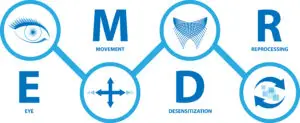
This is where a process like Eye Movement Desensitization and Reprocessing, or EMDR, begins to take shape within the warehouse. It does not force the manager to confront everything at once. Instead, it invites the system to choose one box—a specific one—and bring it into the center of the warehouse floor. This is the target event. It is not stumbled upon accidentally this time. It is approached with care, with preparation, with a sense that the manager will not have to face it alone.
As the box is lifted and carried inward, there may already be a shift in the atmosphere. The manager recognizes it. There is familiarity there, even before it is fully opened. The rest of the warehouse continues in the background, but attention narrows to this one space, this one moment. Slowly, the box is set down in the center of the floor, and the lid is opened.
The contents are poured out.
What had been sitting quietly off to the side is now fully visible again—images, sensations, emotions, fragments of experience that were never fully processed. And almost immediately, the system reacts. The warehouse does not experience this as something distant or resolved. It feels immediate, present, alive. The same surge begins to move through the system as it did before. The air feels heavier, the lights harsher, and chemicals like cortisol and norepinephrine begin circulating again, signaling urgency throughout the warehouse.
The manager responds as it always has. From where it stands, this is happening now. The sense of time collapses, and the difference between past and present becomes blurred. Looking at the contents spread across the floor, it feels as though everything is “on fire” again—overwhelming, urgent, unsafe. The instinct is to react, to contain, to survive.
But this time, something is different.
Above the warehouse floor, the executive office is no longer dark or closed off. The doors are open. Light spills outward. And slowly, the executive presence steps onto the balcony, looking down at what is unfolding below. There is no urgency in its movement, no panic in its voice. It simply observes for a moment before speaking.
“Hey… what are you doing?”
The manager, already activated, responds quickly, tension in its voice. “What do you mean what am I doing? Can’t you see this fire?”
From where it stands, the intensity is undeniable. Everything about the experience says this is happening right now.
But the response from above is steady, grounded, and calm. “That’s not on fire anymore,” the executive office says. “That was five years ago.”
There is a pause, a moment where the words don’t quite fit with what the manager is feeling.
“Five years ago?” the manager asks, uncertain.
“Yes,” comes the reply. “It was five years ago. It’s not happening now.”
And in that moment, something begins to shift. Not all at once, not in a way that erases what is in front of the manager, but in a way that introduces something new into the system. The manager is no longer alone. There is communication now—real, active communication—between the part of the warehouse that reacts and the part that understands time, context, and perspective.
As this process continues, that connection strengthens. The manager begins to check in, even as it feels the intensity of what is in front of it. The executive office remains present, engaged, offering grounding and clarity that was not available when the experience first occurred. The contents of the box are still there, but they begin to change in how they are experienced. Instead of being relived as an ongoing emergency, they start to be seen as something that happened, something that has a beginning and an end.
Gradually, the intensity begins to soften. The alarms do not need to sound as loudly. The fragments on the floor begin to organize themselves. Pieces that once felt chaotic start to make sense in relation to one another. The meaning attached to the experience begins to shift, allowing more balanced and adaptive beliefs to form.
The warehouse manager begins to regulate. The sense of urgency eases. The system is still engaged, still aware, but no longer overwhelmed in the same way. And as this happens, something important becomes possible. The manager can finally do what it was unable to do before.
It begins to gather the contents.
One piece at a time, carefully, deliberately, placing them back into the box. This time, the edges align. The instability that once made the box feel unsafe to close is no longer there. When the lid is lowered, it does not resist.
It closes.
Fully.
The manager pauses, noticing the difference, and then seals the box, labels it, and places it onto the conveyor belt. It moves away from the center of the warehouse, carried toward the long-term storage area.
In the Hippocampus, it is filed alongside the rest—stored, organized, accessible if needed, but no longer active on the warehouse floor. It no longer interrupts the flow of new experiences. It no longer signals danger in moments that are safe.
And as that box settles into place, the warehouse itself begins to change. The manager no longer has to step around it or scan every incoming package for its resemblance. The space it once occupied is now open. There is less tension in the air, less urgency in the movement. Over time, as more boxes are processed in this way, the patterns that once shaped the warehouse begin to soften.
Positive experiences begin to arrive and move through the system more fully, no longer reduced or filtered. They retain their size, their color, their emotional depth. Negative experiences, when they occur, are experienced for what they are, not amplified by everything that came before. The system becomes more flexible, more balanced, more able to respond to the present moment as it is.
The warehouse is still active. It still protects. It still responds.
But it is no longer carrying the same weight of what has been left unfinished.
And in that shift, there is more space—not just for order, but for something that may not have felt fully possible before.
The space to feel.
The space to respond.
The space to live in the present moment, without everything being shaped by what once had nowhere to go.
Got boxes?